Tips & Challenges

Point of inflexion and concavity

The concept of increasing function, point of inflexion and concavity can be understood with an illustration.


Concavity

a. Strictly increasing. f(x) is strictly increasing when f'(x) > 0. ( x<1.423 or x> 2.577) . These points also coincide with the maximum and minimum point.

b. Strictly decreasing. f(x) is strictly decreasing when f'(x) < 0. (1.423  < x <  2.577)

c. Point of inflexion is the point where the curve changes curvature or concavity. f'(x) does not change sign, and  f” (x) = 0 and changes sign. In the above graph, the curve changes from convex to concave at x = 2.

d. Concave upwards. f(x) concave upwards when f”(x) > 0 or f'(x) is strictly increasing. f(x) concave upwards at x> 2, after f'(x) reaches a minimum, at the point of inflexion.

e. Concave downwards or convex. f(x) concave downwards when f”(x) < 0 or f'(x) is strictly decreasing. f(x) concave downwards for x < 2.

Transformation of graphs: Order of Transformation

In the transformation of graphs, knowing the order of transformation is important. Knowing whether to scale or translate first is crucial to getting the correct transformation.

Let’s look at this example to illustrate the difference:

Example 1

Original point on y=f(x) is x=8

For f(2x+4), we do translation first, then scaling. ie. Move left by 4 units, then scale parallel to the X axis by a factor of 1/2. Hence, the original point becomes x= (8-4)/2 = 2

If we want to do scaling first, we need to factorise into f 2(x+2). So scale parallel to the X axis by a factor of 1/2, then move left by 2 units. Hence, the original point becomes x= (8/2)-2 = 2

Example 2

Describe the transformation of 3f(2x-4) + 5.

Translate 4 units in the positive X direction

Scale by a factor of 1/2 parallel to the X axis

Scale by a factor of 3 parallel to the Y axis

Translate 5 units in the positive Y direction

In summary,

cf(bx+a)+d = Translate by a units in the negative X direction, then scale by a factor of 1/b parallel to the X-axis, then scale by a factor of c parallel to the Y-axis, then translate by d units in the positive Y direction.

c[f a(x+b)]+d = Scale by a factor of 1/a parallel to the X-axis, then translate by b units in the negative X direction, then scale by a factor of c parallel to the Y axis, then translate by d units in the positive Y direction.
 

Quick binomial expansion using GC

Binomial expansion can be done quickly using the GC.

Consider binomial expansion of Tex2Img_1396931745, where a is a real number, and q is a fraction or negative integer.

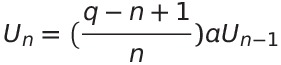
The recurrence formula for the coef works out to be

Tex2Img_1396931939

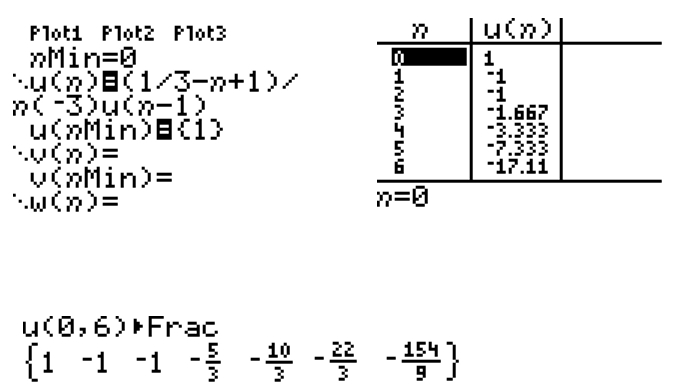
Example 1

Expand Tex2Img_1396932117  in ascending powers up to and including the term in Tex2Img_1396932205

Using TI 84 Plus (OS 2.55)

bin

Therefore, the expansion is

Tex2Img_1396933315


The recurrence formula can also be used to expand in descending powers of x.

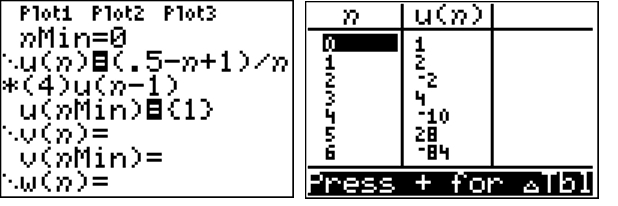
Example 2

Expand Tex2Img_1397528779 in descending powers of x up to the 7th term.

Using TI 84 Plus (OS 2.55)

1

Therefore, the expansion is

Tex2Img_1397529466


Sketching graphs of polynomial functions

Sketching graphs of polynomial functions are useful in graphing techniques, and solving inequalities.

Steps

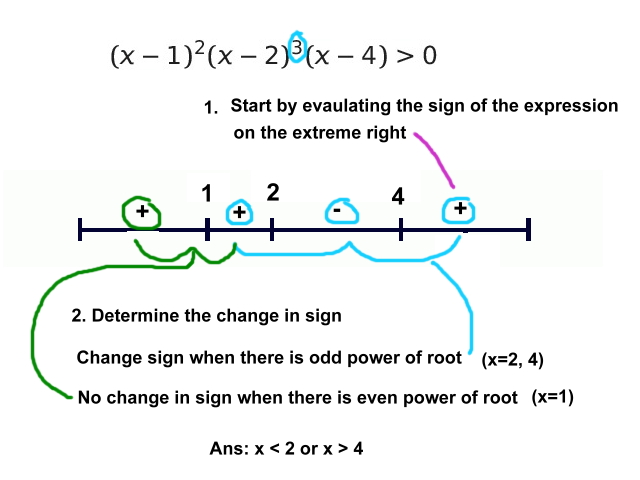
1. First mark down the roots of the polynomial function.

2. Decide how the tail ends behave, whether it is above or below the X axis. This can be determined from the coef of the highest power. For instance, if the polynomial is of degree 6 and the coef of the highest power is positive, then when X approaches either positive or negative infinity, the function approaches positive infinity, so the tail ends are above the X axis.

3. Determine how the function behaves at the roots. When there are 3 or more odd number of roots at the same point, there is a point of inflexion at the root. When there are 2 or more even number of roots at the same  point, there is a minimum or maximum point at the root.

Example 1

graph 1

Example 2


2

All about TI 84 Plus graphing calculators

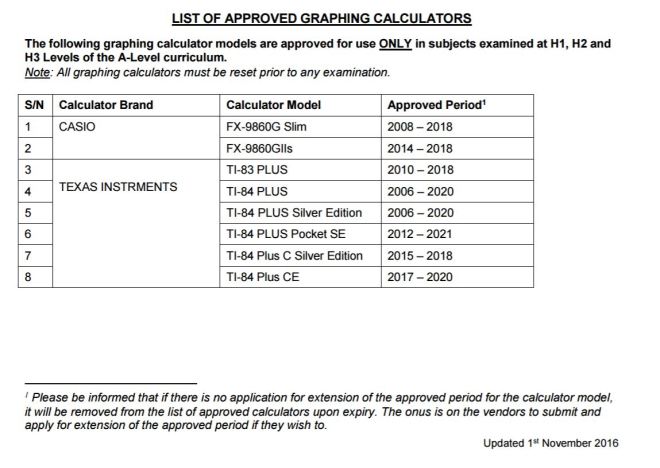
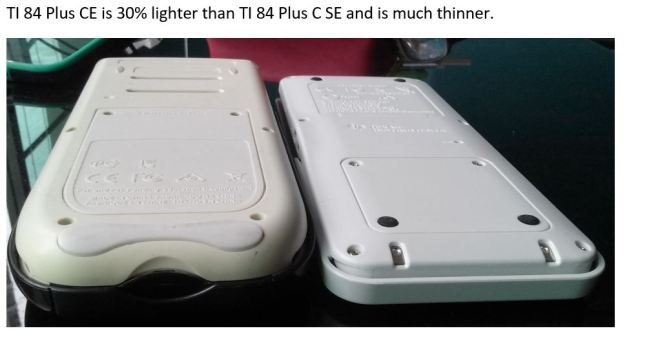
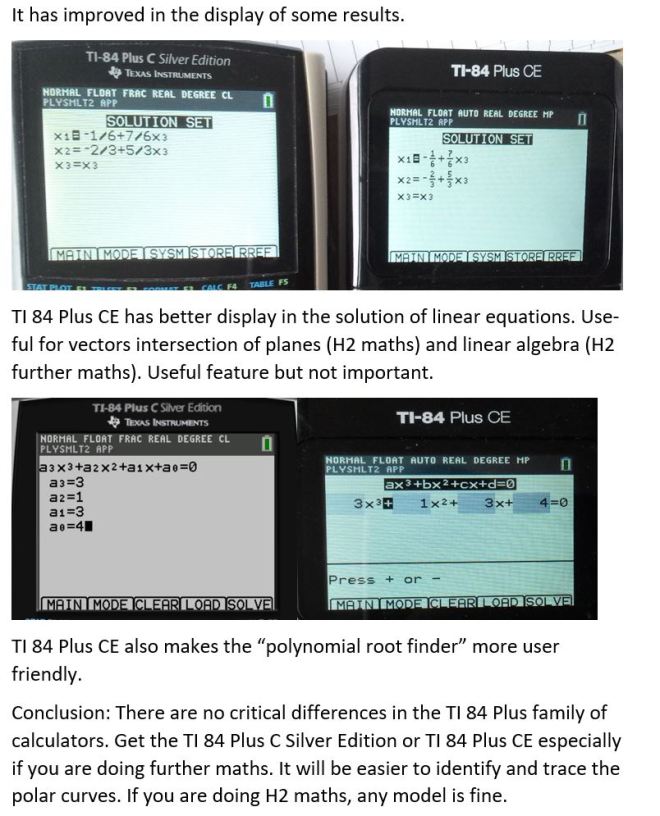
All the functions of TI 84 Plus series of calculators are essentially the same and can be used in Alevel.

approved-calcualtor

1

11

12


Choosing a suitable value for binomial approximation

1

Example 1

2

3

If the expansion is of other forms, can try the method shown in example 2.

Example 2

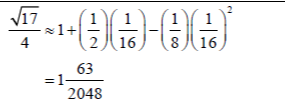
Suppose you are asked to expand Tex2Img_1396431523 using binomial expansion, then use the results to approximate Tex2Img_1396431669

How do you select a suitable value for the approximation?

Step 1

Make sure the value selected is within the range of values for which the expansion is valid. In this example, the valid range is from -4 to 4.

Step 2

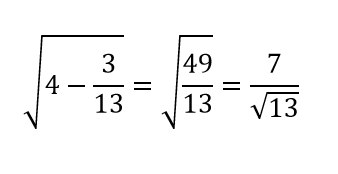
4-x = (13 / perfect square) or (perfect square/13)

So 4-x = (13 /4 or 13/9) or (49/13)

x= 3/13 or 3/4 or 23/9

Choose the smallest value 3/13 as value closer to 0 gives better approximation.

Therefore, Capture

LHS can be approximated using the binomial expansion. Hence Tex2Img_1396431669 can be approximated.

Optimising the graph settings in GC

Suppose we are required to solve the following inequality, given that x is positive

eqn

Using TI-84 Plus (OS 2.55)

adjust graph settings


Using GC to determine the nature of stationary points

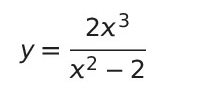
Suppose we are required to determine the nature of stationary points for the following:

y

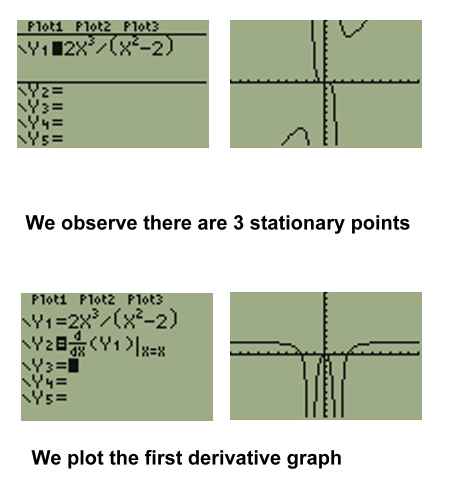
Using TI-84 Plus (OS 2.55) det

Observation of stationary points:

Left stationary point: First derivative changes from +ve to -ve. Therefore, it is a maximum point

Middle stationary point: No change in sign of deriative. Therefore, it is a point of inflexion.

Right stationary point. First derivative changes from -ve to +ve. Therefore, it is a minimum point

Finding the general term in binomial series

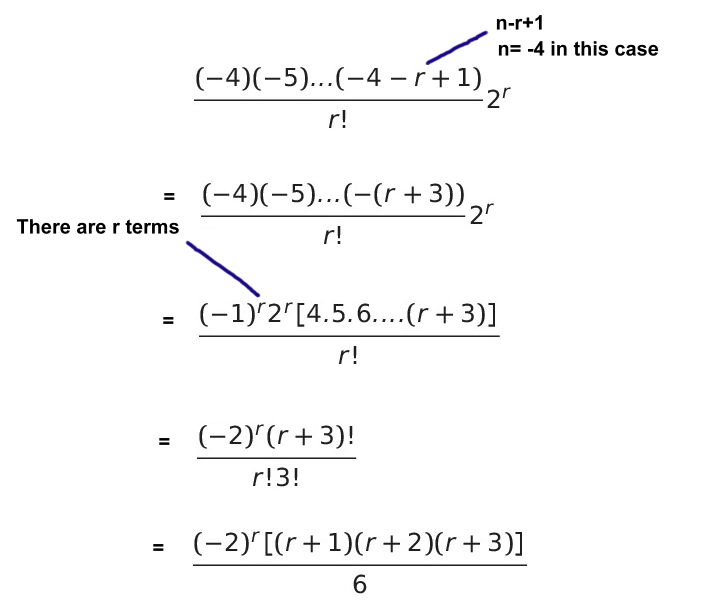
In Amath, finding the general term in binomial expansion is easy, because we can easily evaluate nCr.  However, finding the general term in H2 math can be much more challenging because n can be a fraction or negative integer.

For example

binomial series


binomial series solution


These type of questions have appeared in JC assignments. Fortunately, it has not appeared in A level exam for the past 10 years. Nevertheless, it is still good to learn how to derive the general term 🙂