Transformations of graph can be written in terms of functions, so we can see the sequence of transformations.
Example 1

Example 2

Transformations of graph can be written in terms of functions, so we can see the sequence of transformations.
Example 1
Example 2
Problem
Vegetarian club consists of 2 married couples and 8 singles. The club is to select a delegation of 4 members to participate in an overseas conference. Find the probability that the delegation contains exactly one married couple.
Answer: 8/45
Solution
Case 1: 1 couple + 1 of the other couple + 1 single
(2 couples choose 1 couple) X (2 choose 1 from the other couple) X (8 singles choose 1) = 32
Case 2: 1 couple and 2 singles
(2 couples choose 1 couple) X (8 singles choose 2) = 56
No restrictions = 12 C 4 = 495
Probability = (32+56) / 495 = 8/45
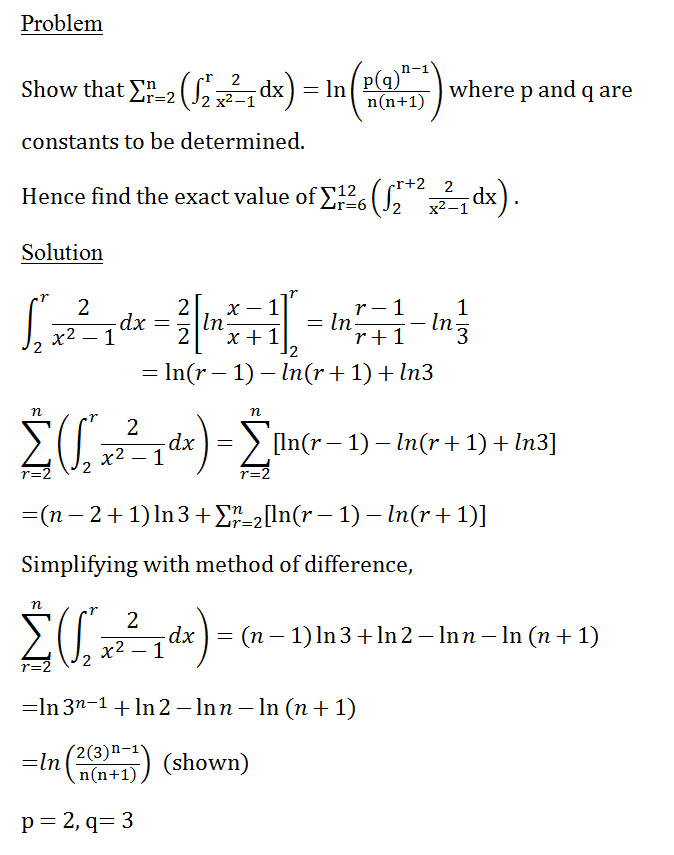
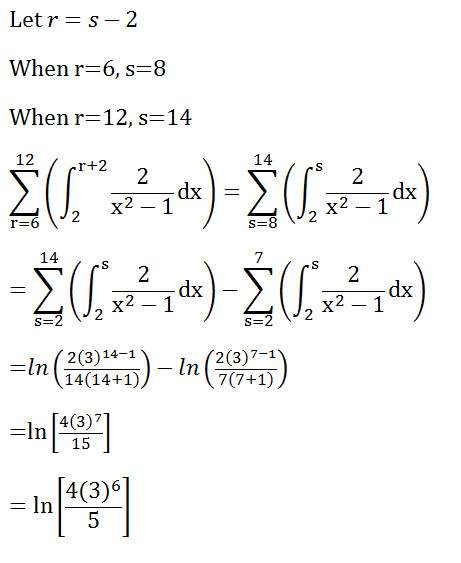


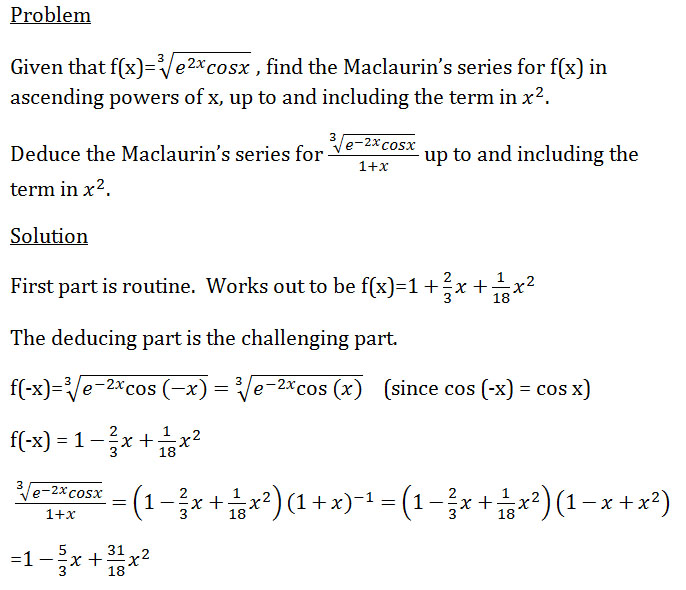
Consider the following 3 cases:

Problem
A bag contains 10 orange-flavoured, 14 strawberry-flavoured and 16 cherry-flavoured sweets which are of identical shapes and sizes. Benny selects a sweet at random from the bag. If it is not cherry-flavoured, he replaces it and selects another sweet at random. He repeats the process until he obtain a cherry-flavoured sweet. Calculate the probability that
i) the first sweet selected is strawberry-flavoured and the fourth sweet is orange-flavoured;
ii) he selects an even number of sweets
Solution


 JC A Level H2 Math Tuition Singapore
You must be logged in to post a comment.