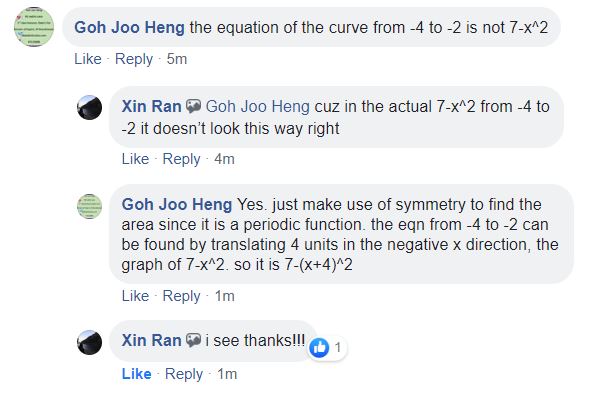
Example
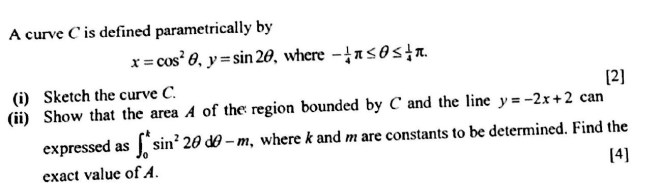
Suppose we want to sketch the curve C and the line y=-2x+2 on the same graph
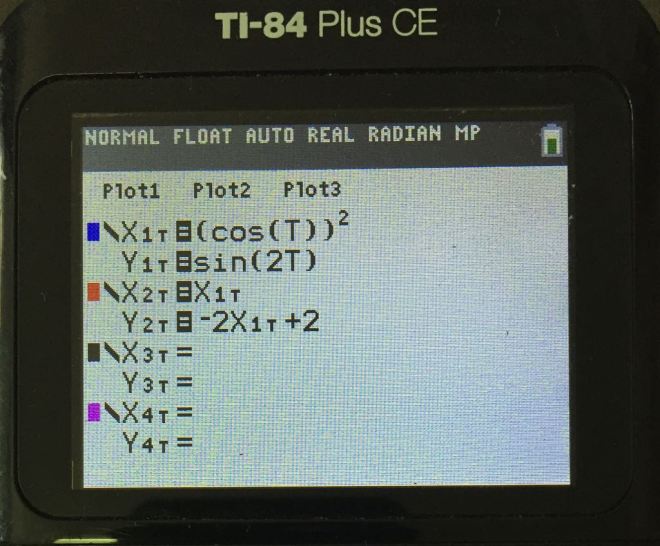
Note how the line y-2x+2 is entered.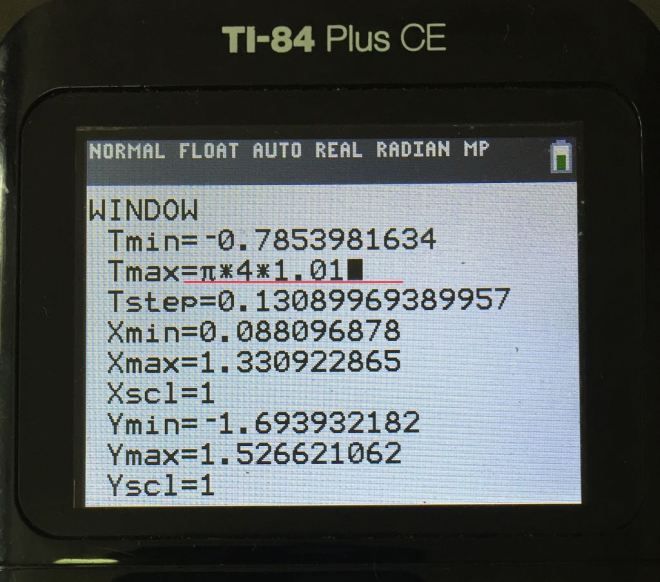
Adjust the Tmax to 1% more so the graph displays correctly.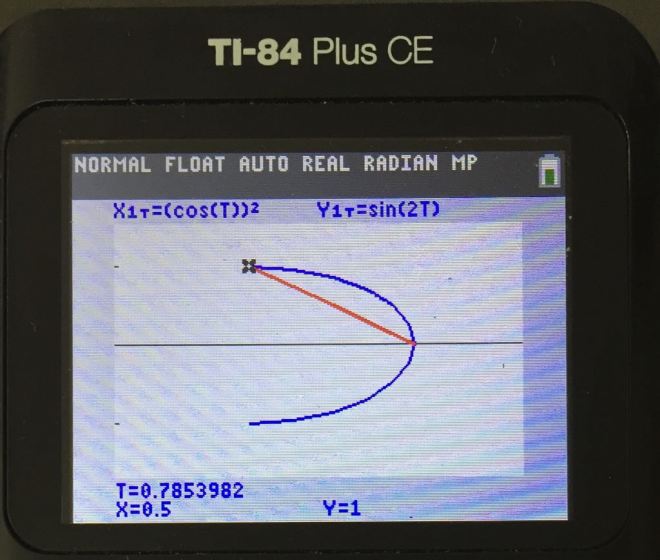
Usually the sequence of transformation can be found by the replacement method. However, it can be tough to find the replacement for complicated functions. For such cases, we can use the general linear transformation c f(bx+a)+d to find the sequence.
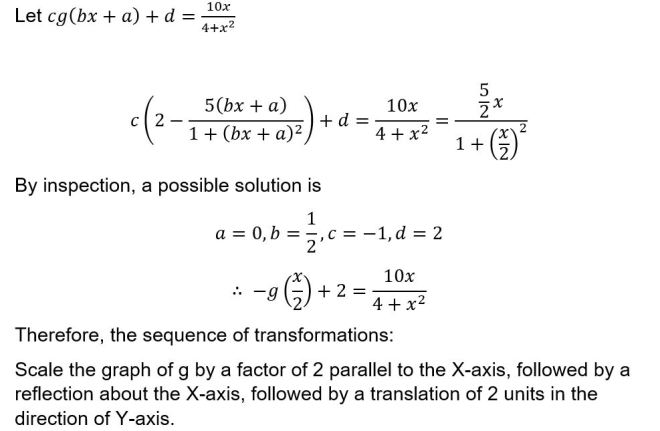
cf(bx+a)+d = Translate by a units in the negative X direction, then scale by a factor of 1/b parallel to the X-axis, then scale by a factor of c parallel to the Y-axis, then translate by d units in the positive Y direction.
Example
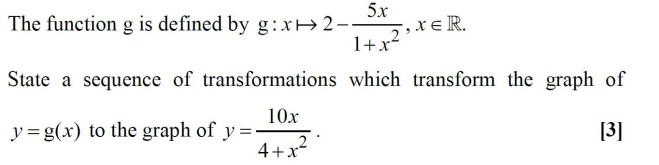
Solution

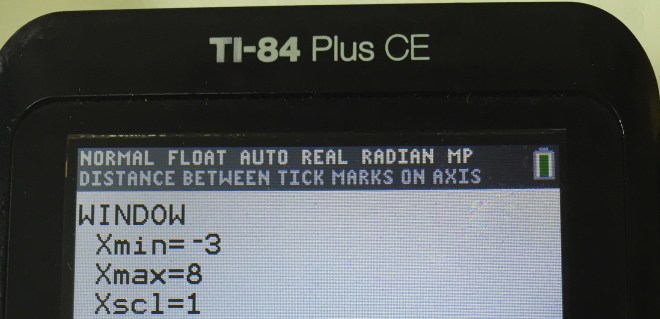
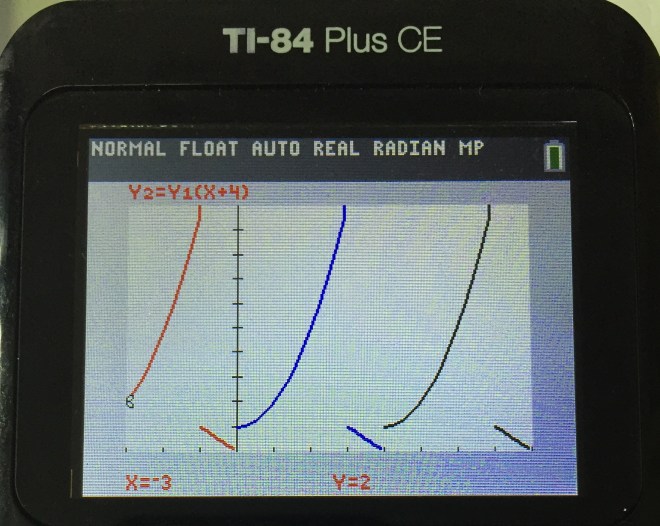
Suppose we want to sketch the graph from -3 to 8.
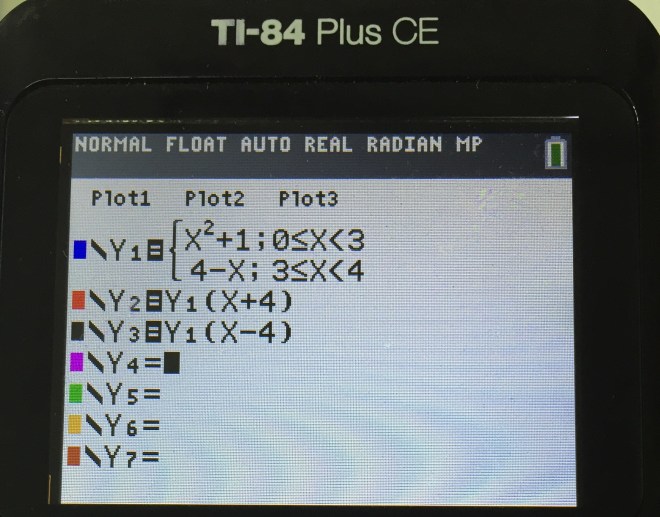
2. Adjust the window setting to the required domain.
3. Trace the end point at -3 since it is not 1 complete cycle.
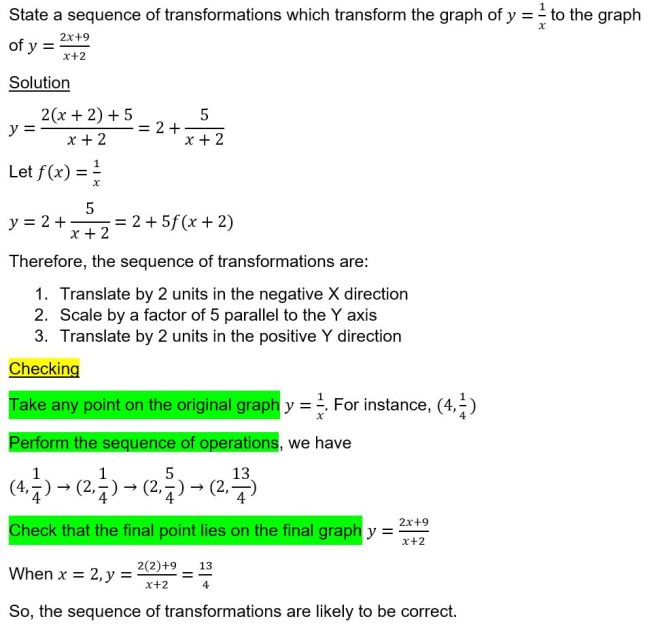
Advanced graph transformation can be done in stages, using the replacement method. Each time, we replace x or y.
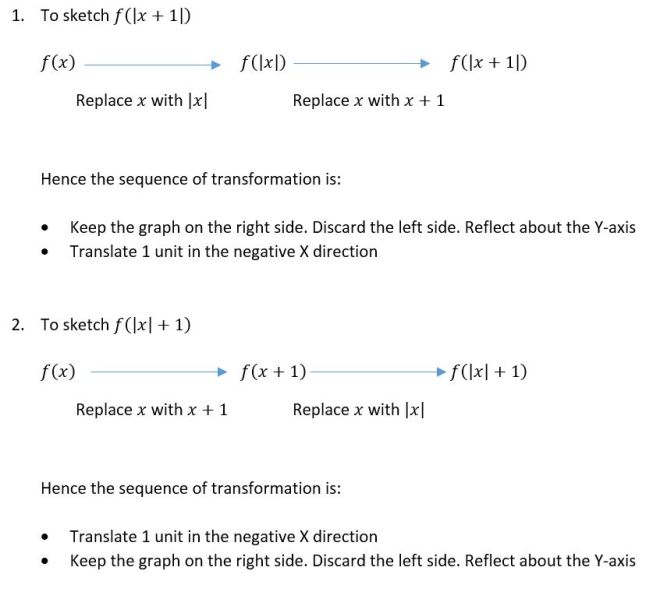
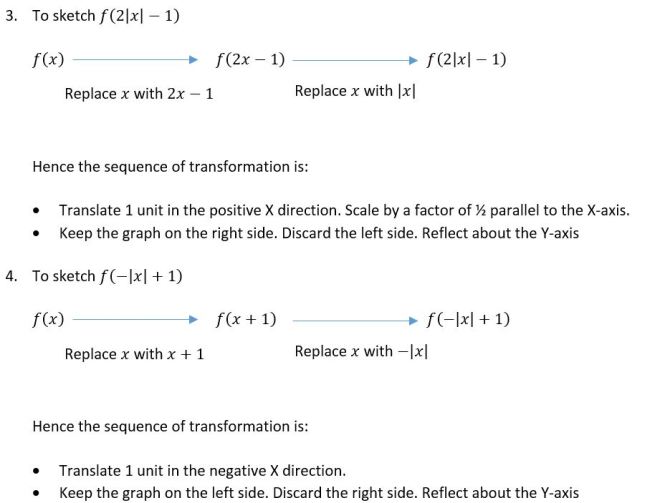
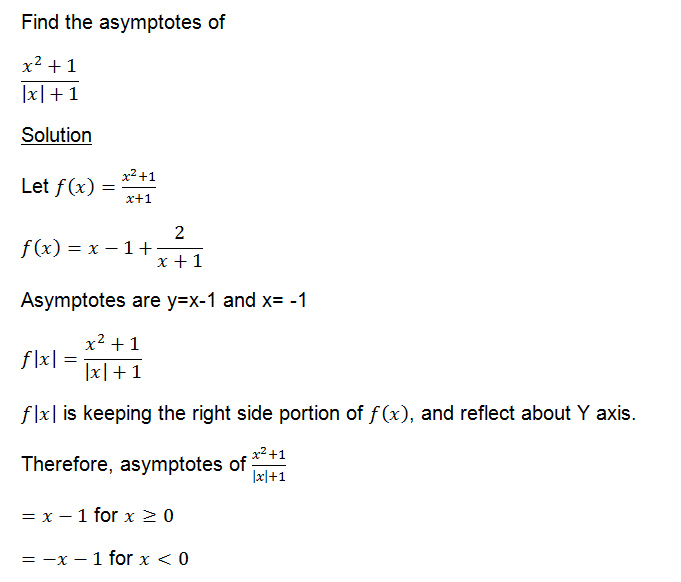
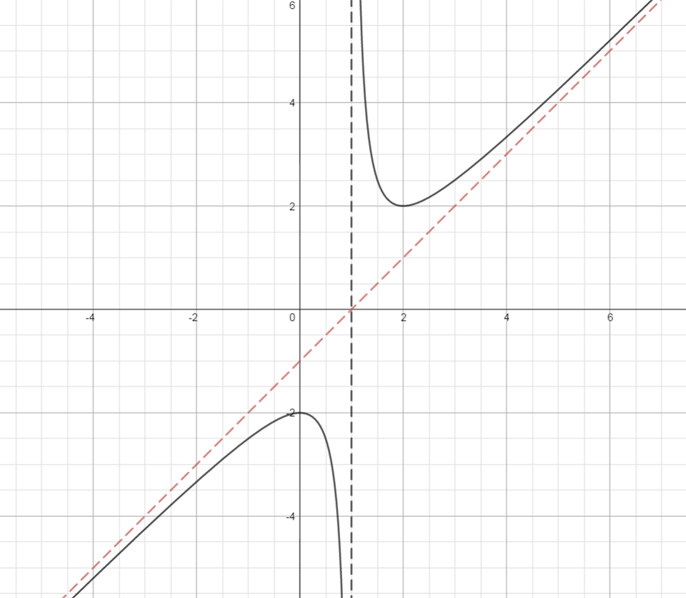
Many students have difficulty with the graph transformation of oblique asymptote. Consider the oblique asymptote y = x-1 (red line)
i) y= 1/ f(x)
f(x) approaches infinity as x approaches infinity. 1 divided by infinity is 0.
Hence oblique asymptote y=x-1 becomes horizontal asymptote y= 0
For y= 1/ f(x), any oblique asymptote y=ax+b in f(x) will become horizontal asymptote y= 0
ii) y= f ‘ (x)
The gradient of y= x-1 is 1. Hence oblique asymptote y=x-1 becomes horizontal asymptote y= 1
For y= f ‘ (x), any oblique asymptote y=ax+b in f(x) will become horizontal asymptote y= a
iii) y= f(2x+1)
Let original asymptote be f(x) = x-1
Therefore, f(2x+1) = (2x+1)-1 = 2x
Hence oblique asymptote y = x-1 is transformed to y=2x.
This method can be applied to any oblique asymptote.
This question was posted by a student.
” What is the series of transformation from f(3-x/2) to f(x)?”
Here are 3 different methods to solve it.
Method 1
Let f(3-x/2) = g(x)
Let u=3-x/2
x= -2u+6
f(u)=g(-2u+6)
f(x)=g(-2x+6)
Therefore, the sequence of transformation is
Translate 6 units in the negative X direction.
Scale by a factor of 1/2 parallel to the X-axis.
Reflect about the Y-axis
Method 2a
Apply f(-2x) to f(3-0.5x).
f(-2x) = f[3-0.5(-2x)] = f(x+3)
ie. Scale parallel to the X axis by a factor of 0.5. Then reflect about the Y axis
Apply f(x-3) to f(x+3) to get f(x)
ie. Translate 3 units in the positive X direction
Method 2b
Apply f(x+6) to f(3-0.5x) to get f(-0.5x)
ie. Translate 6 units in the negative X direction.
Apply f(-2x) to f(-0.5x) = f(x)
ie. Scale parallel to the X axis by a factor of 0.5. Then reflect about the Y axis.
Method 3
f(3-x/2) is transforming f(x) by
A:Translate 3 units in the negative X direction
B: Scale by a factor of 2 parallel to the X axis
C: Reflect about Y axis.
So to get back f(x), we reverse the transformation:
C’: Reflect about Y axis
B’: Scale by a factor of 1/2 parallel to the X-axis.
A’: Translate 3 units in the positive X direction
Comments
Method 1 and 2 are the forward approach. Method 3 is the reverse approach.
Method 1 is the preferred approach as it is easier and faster.
 JC A Level H2 Math Tuition Singapore
You must be logged in to post a comment.