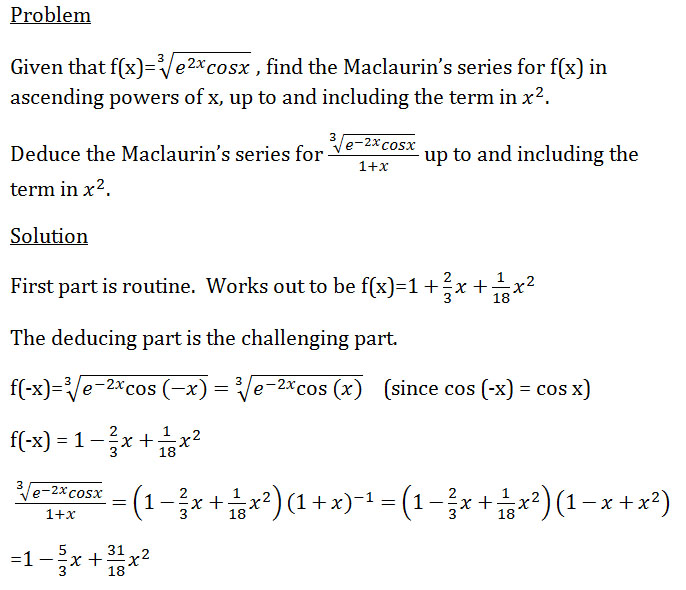
Challenging Maclaurin’s series problem 2
Problem
A bag contains 10 orange-flavoured, 14 strawberry-flavoured and 16 cherry-flavoured sweets which are of identical shapes and sizes. Benny selects a sweet at random from the bag. If it is not cherry-flavoured, he replaces it and selects another sweet at random. He repeats the process until he obtain a cherry-flavoured sweet. Calculate the probability that
i) the first sweet selected is strawberry-flavoured and the fourth sweet is orange-flavoured;
ii) he selects an even number of sweets
Solution


Use implicit differentiation to differentiate the following with respect to x:
y=x(x+1)(x+2)(x+3)(x+4)(x+5)
Solution
ln y= lnx+ln(x+1)+ln(x+2)+ln(x+3)+ln(x+4)+ln(x+5)


In how many ways can 9 balls of which 4 are red, 4 are white and 1 black be arranged in a line so that no red ball is next to the black?
Answer: 175
Solution
Case 1: 1st ball is black in the whole row of 9 balls
Then the 2nd ball must be white. The rest of the 4 red and 3 white balls can be arranged in  = 35 ways
Case 2: last ball is black
Then the 2nd last ball must be white. The rest of the 4 red and 3 white balls can be arranged in = 35 ways
Case 3: Black ball is not the 1st or last ball
Then the black ball must be between 2 white balls. Consider WBW as one unit. Together with 4 red balls and 2 white balls, these can arranged in  = 105 ways
Using the addition principle, total number of ways = 35+35+105= 175
At Nuts supermarket, a discount is offered on Almonds, Cashew and Walnuts if more than a certain weight of it is bought. On a particular grocery shopping trip, King Kong bought a total of 12 kg of nuts as follows:
| Types of Nut | Price per kg ($) | Discount offered |
| Almond | 14 | 20% for more than 6 kg bought |
| Cashew | 9 | 15% for more than 3 kg bought |
| Walnuts | 11 | 10% for more than 2 kg bought |
King Kong bought at least 3.5 kg of each type of nut and spent $124.03 after an overall discount of $10.17. Find the weight of each type of nut King Kong bought from the supermarket.
Solution
We know that discount is obtained from the purchase of cashew and walnuts, since the amount bought is at least 3.5 kg of each type. However, we do not know whether any discount is obtained for the purchase of almonds.
Therefore, we make the assumption that the amount of almonds bought is less than or equal to 6kg, and hence no discount. If the solution turns out to be between 3.5 to 6kg inclusive, we accept the solution. Else we reject and change the assumption to almonds bought is greater than 6kg, reformulate and solve the equations again.
Let a, b and c be the number of kg of almonds, cashew and walnuts bought respectively.
Therefore a+b+c= 12 (Eqn 1)
Assume 
14a+b(0.85×9)+c(0.9×11)=124.03
14a+7.65b+9.9c=124.03 (Eqn 2)
0.15x9b+0.1x11c=10.17
1.35b+1.1c= 10.17 (Eqn 3)
Solving the 3 equations with GC,
a= 3.8 , b=4.6, c=3.6
Since a is between 3.5 to 6, our assumption and hence solution is valid.
King Kong bought 3.8 kg of almonds, 4.6 kg of cashew and 3.6 kg of walnuts.
Given that k>0, solve the inequality
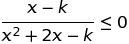
Express your answer in terms of k.
Solution
First, we determine the roots of 

Then we need to determine whether the roots are bigger or smaller than k, so we can sketch the number line.
Since k> 0
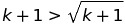

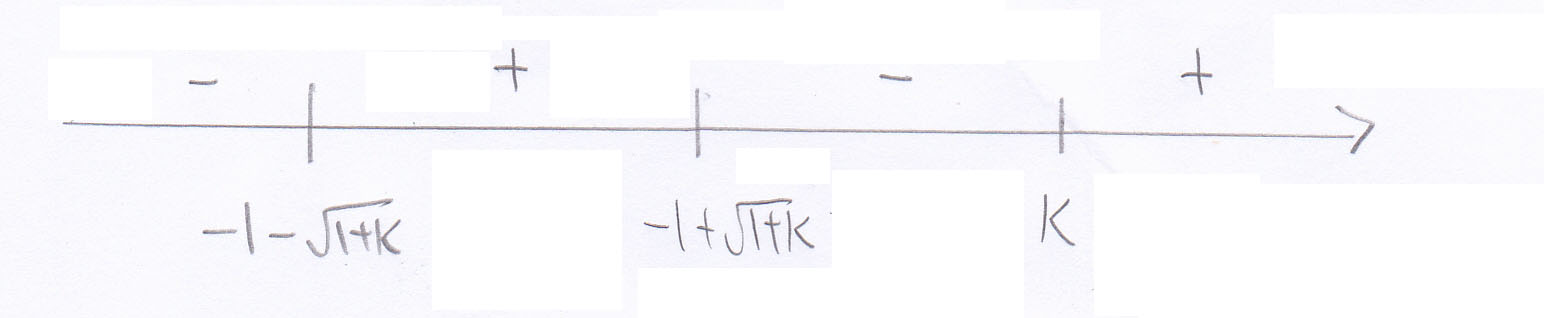
 or
or 
There are a total of 20 amusement rides in a theme park. A child insists on trying at least 5 of the amusement rides. Calculate the number of ways in which this can be done.
Answer: 1042380
Solution
Method 1
20 choose 5 + 20 choose 6 +… 20 choose 20
Using TI 84 OS (2.55)
sum (seq(20 nCr X, X, 5, 20, 1)
= 1042380
Method 2
2^20- (20 choose 0+ 20 choose 1+20 choose 2+20 choose 3+ 20 choose 4)
=1042380
Functions f and g are defined as follows:
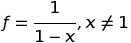

Evaluate 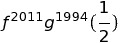
Solution


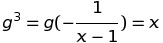
Therefore, both functions f and g repeat itself.
1994 divide by 3 has a remainder of 2. Therefore,
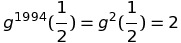
2011 divide by 3 has a remainder of 1. Therefore,

 JC A Level H2 Math Tuition Singapore
You must be logged in to post a comment.