

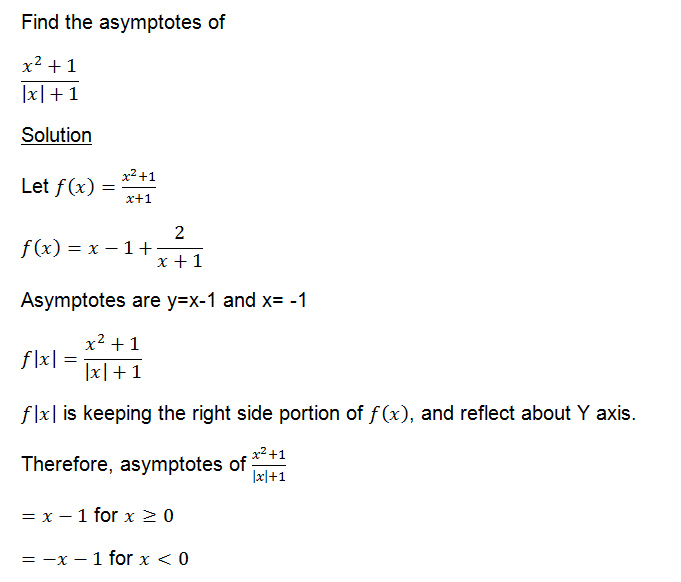

Alternative method


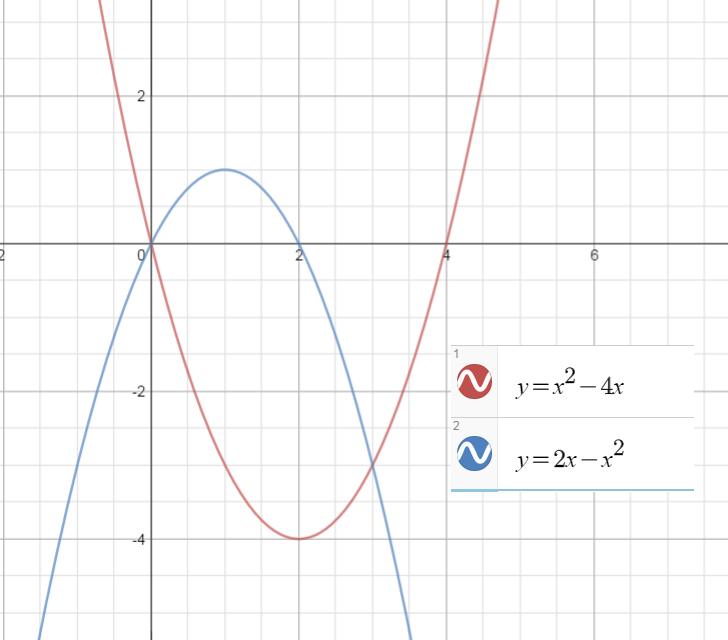
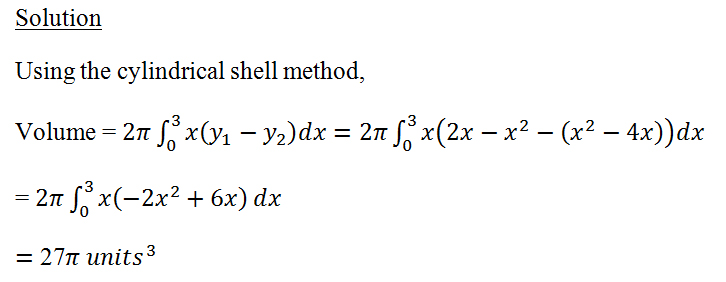
Juggling is a shortcut to long division, especially in the case where the degree of the numerator is the same as the denominator. In H2 math, juggling is a useful technique in finding the asymptote of graphs and integration.

A group of 9 people sits at a triangular table, which is equilateral, with 3 persons at each side of the table. Find the number of different possible arrangements.
Solution
The 3 arrangements below are considered the same

Therefore, number of different possible arrangements = 9! / 3
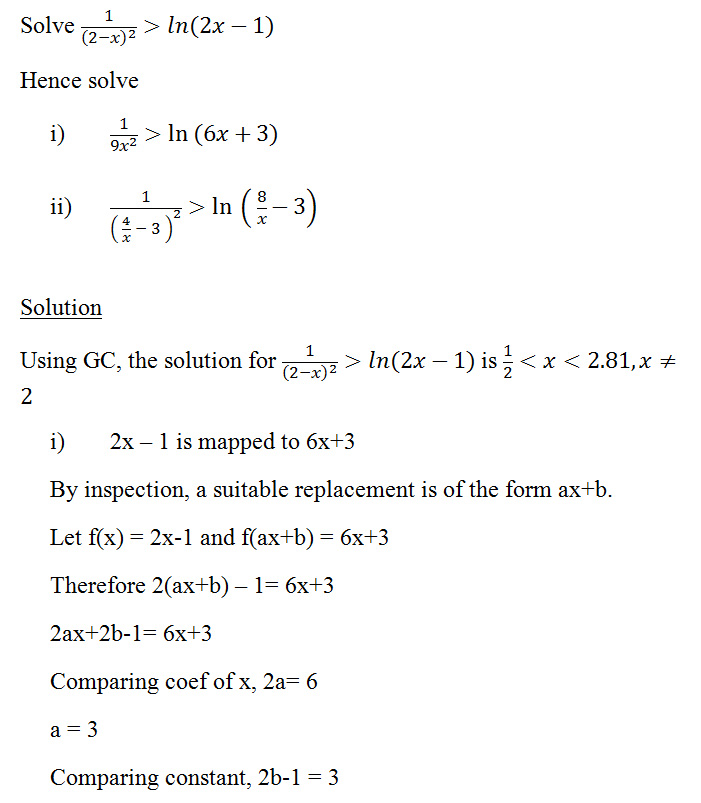
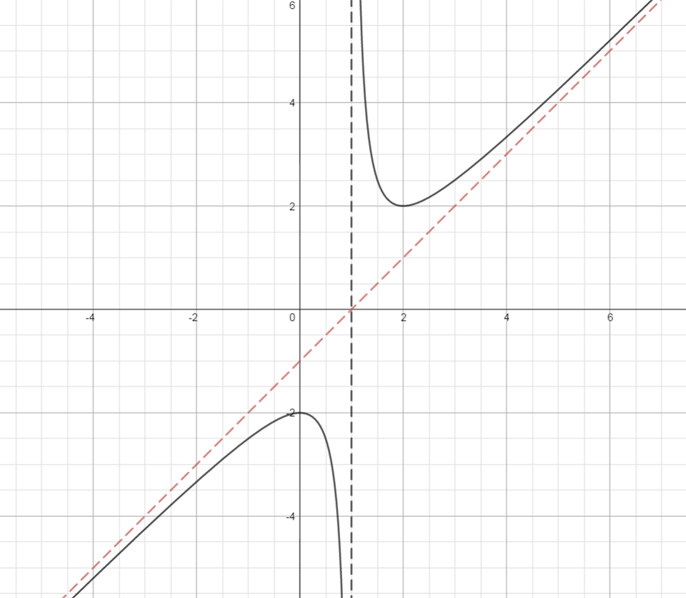
Many students have difficulty with the graph transformation of oblique asymptote. Consider the oblique asymptote y = x-1 (red line)
i) y= 1/ f(x)
f(x) approaches infinity as x approaches infinity. 1 divided by infinity is 0.
Hence oblique asymptote y=x-1 becomes horizontal asymptote y= 0
For y= 1/ f(x), any oblique asymptote y=ax+b in f(x) will become horizontal asymptote y= 0
ii) y= f ‘ (x)
The gradient of y= x-1 is 1. Hence oblique asymptote y=x-1 becomes horizontal asymptote y= 1
For y= f ‘ (x), any oblique asymptote y=ax+b in f(x) will become horizontal asymptote y= a
iii) y= f(2x+1)
Let original asymptote be f(x) = x-1
Therefore, f(2x+1) = (2x+1)-1 = 2x
Hence oblique asymptote y = x-1 is transformed to y=2x.
This method can be applied to any oblique asymptote.
Circular permutations often pose some difficulty to students. Let’s consider the following scenarios:
Scenario A: 10 people to be seated at a round table with 10 identical seats
Number of ways = (10-1)! = 9! = 362880
Scenario B: 5 people to be seated at a round table with 10 numbered seats
Number of ways = 10 P 5 = 30240
Scenario C: 6 people to be seated at a round table with 10 identical seats

There will be 4 identical empty seats. Consider fixing 1 occupied seat, and permutate the other 9 seats around it. There are 4 identical seats among the 9 seats. So number of ways = 9!/4! = 15120

 JC A Level H2 Math Tuition Singapore
You must be logged in to post a comment.