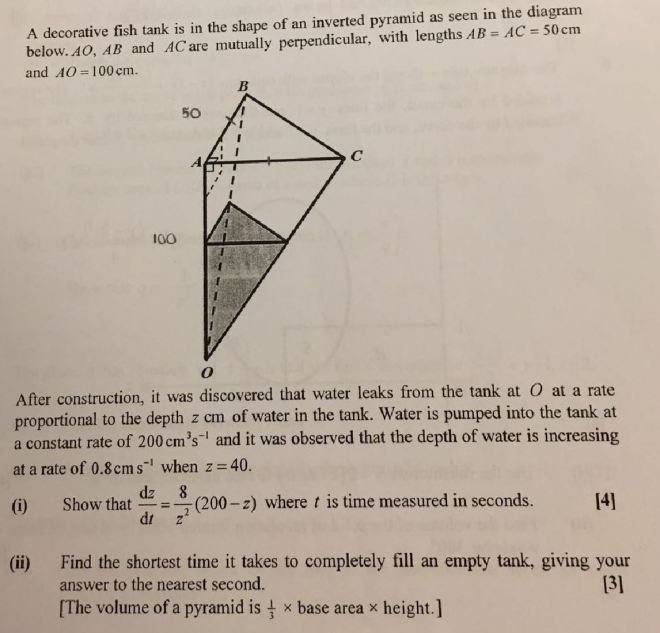
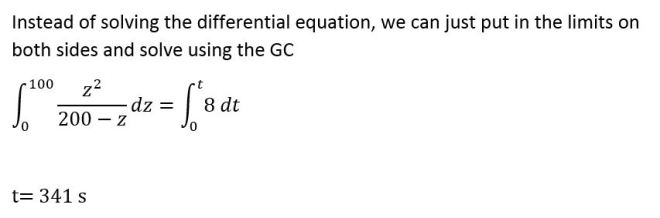
The following example illustrates how we can use GC in Differential equations, and avoid the need to do integration to solve differential equation.
Solution for part ii
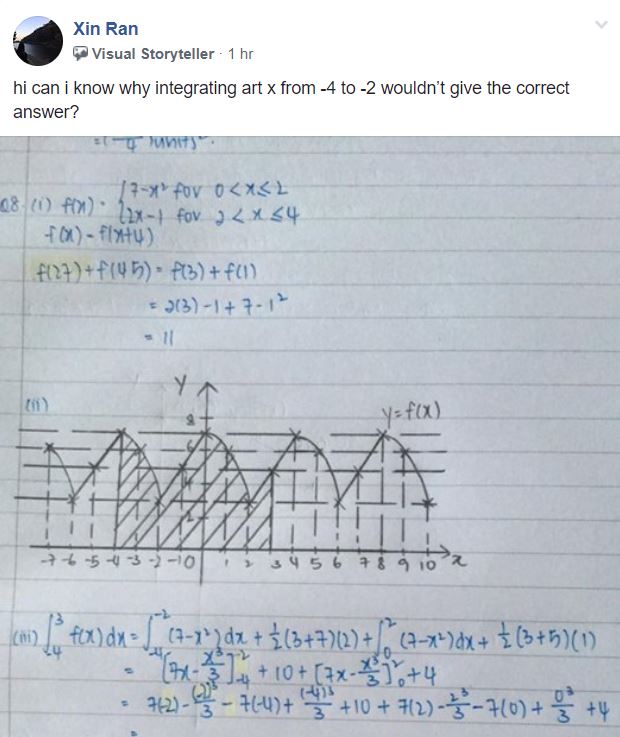
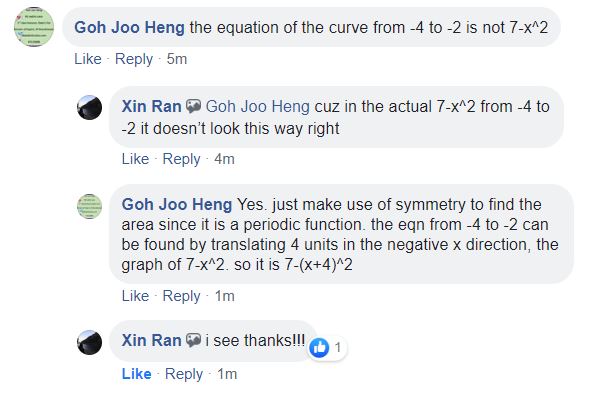
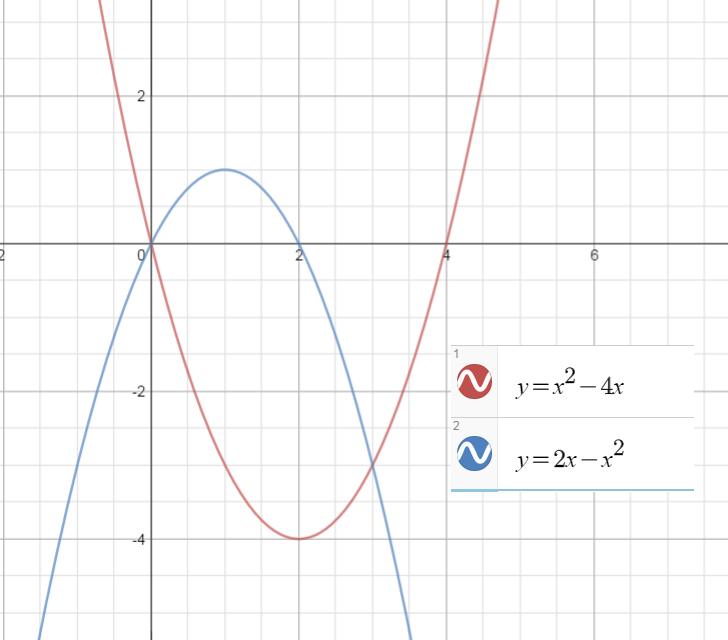
These questions by students illustrate the common misconceptions on volume of revolution:
Question 1
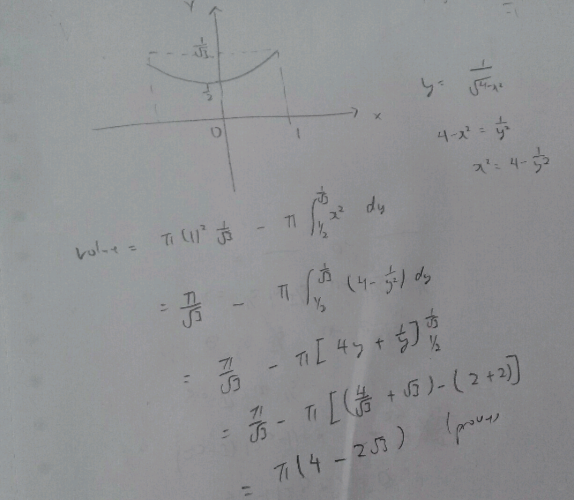
Further queries by student
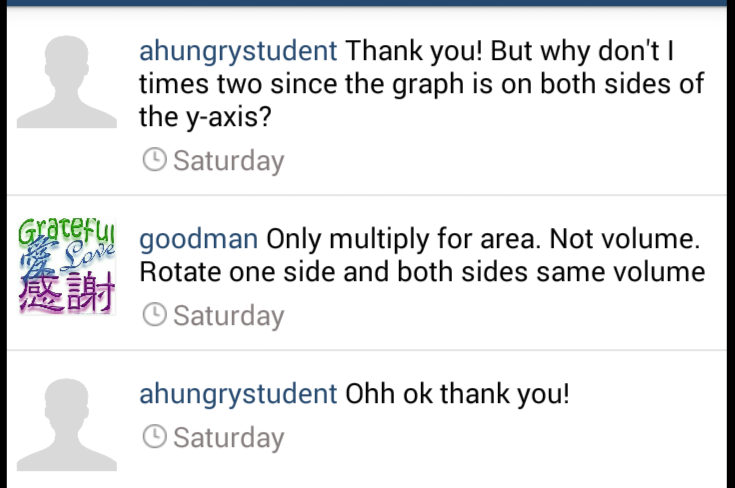
Misconception: Since the region is bounded on both sides of the Y-axis, the volume of revolution needs to be multiplied by 2 when integrate one side.
Clarification: The volume of revolution is the same whether one side of the region is rotated or both sides of the region are rotated. The swept volume of one side or both sides are the same.
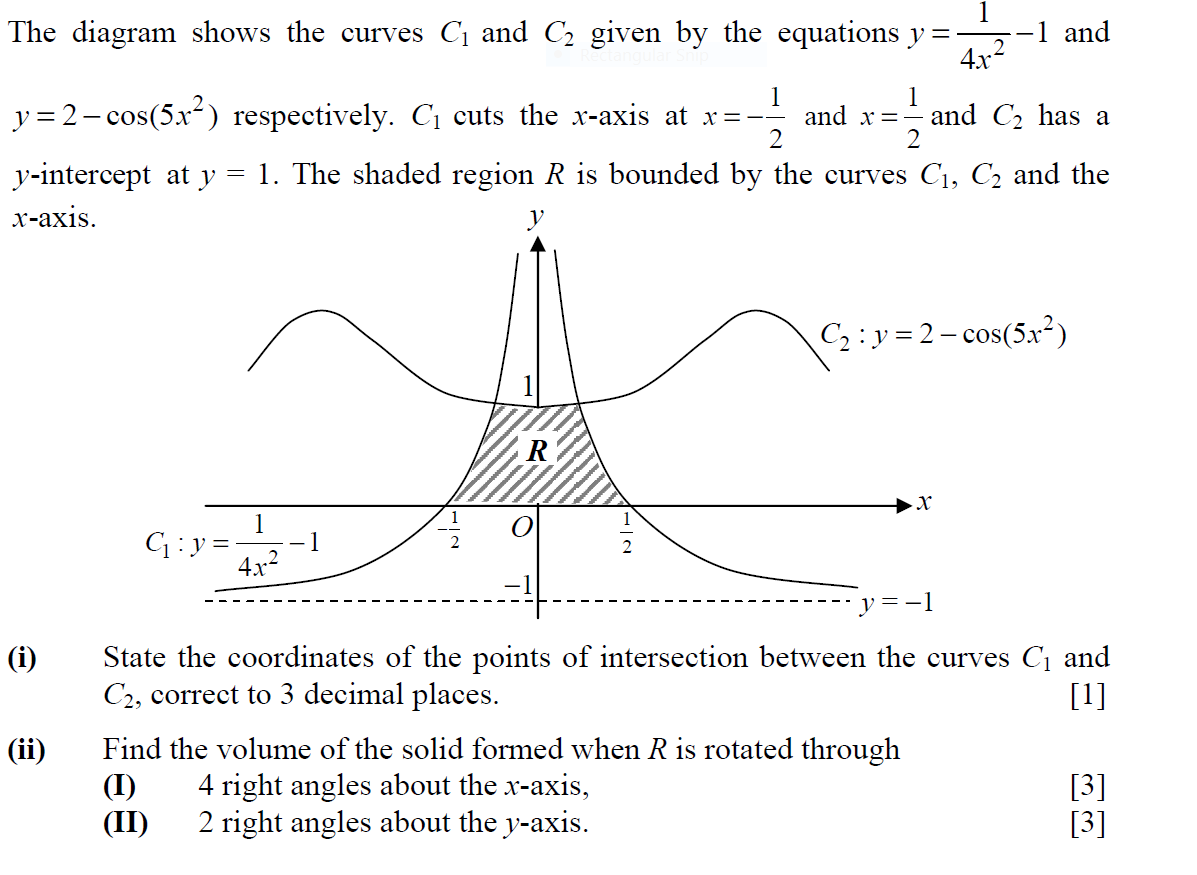
Question 2
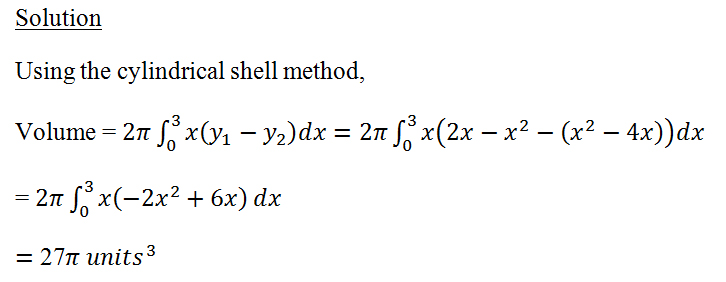
Solution
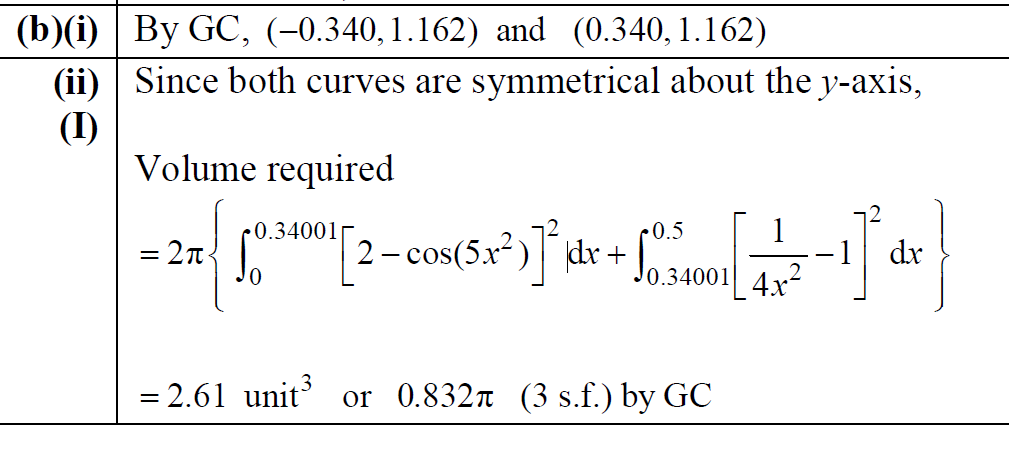
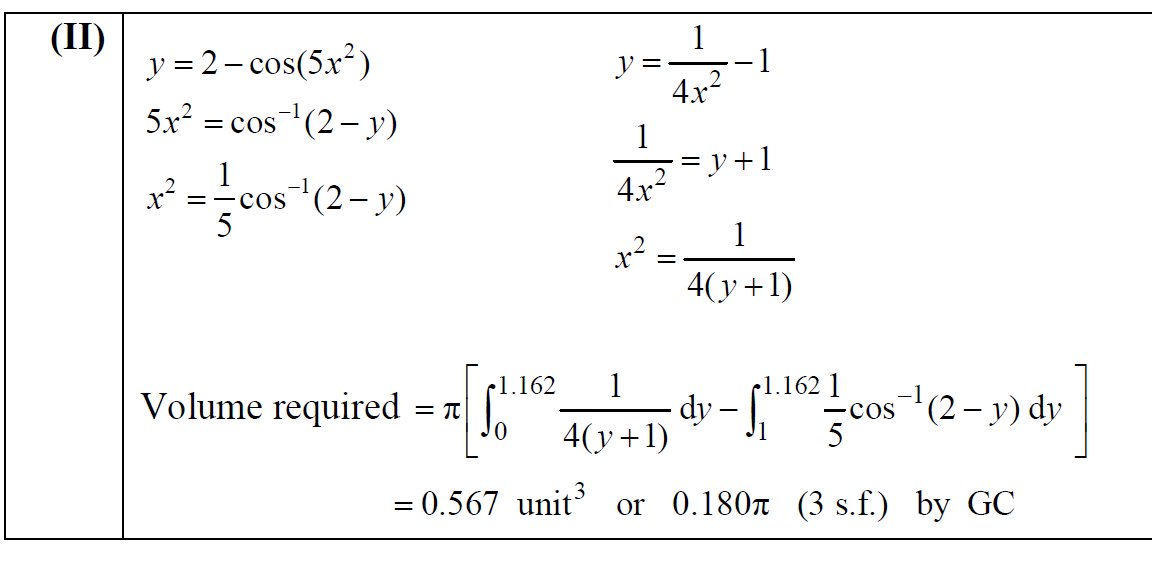
Notice that for part i, the volume needs to be multiplied by 2, whereas for part 2, there is no need.
Student’s queries on part ii:
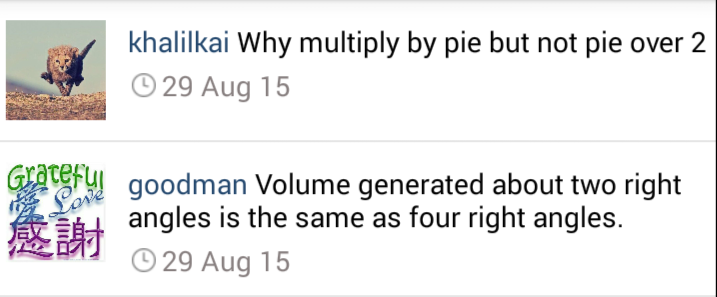
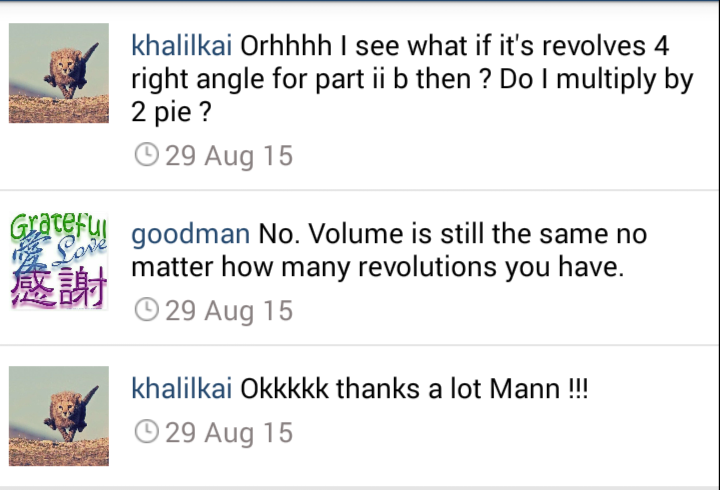
Misconception: That the volume achieved by rotating only 180 degrees is half of the volume of rotating 360 degrees.
Clarification: Since the graph is bounded on both sides, just need to rotate by 180 degrees to obtain the full swept volume. If it is bounded by one side, then need to rotate by 360 degrees to obtain the full swept volume.


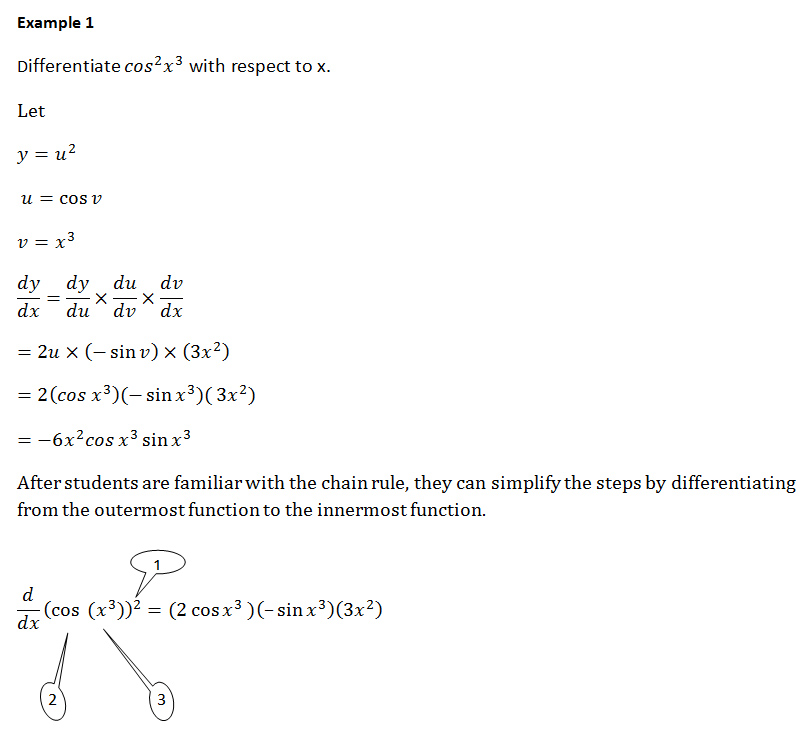
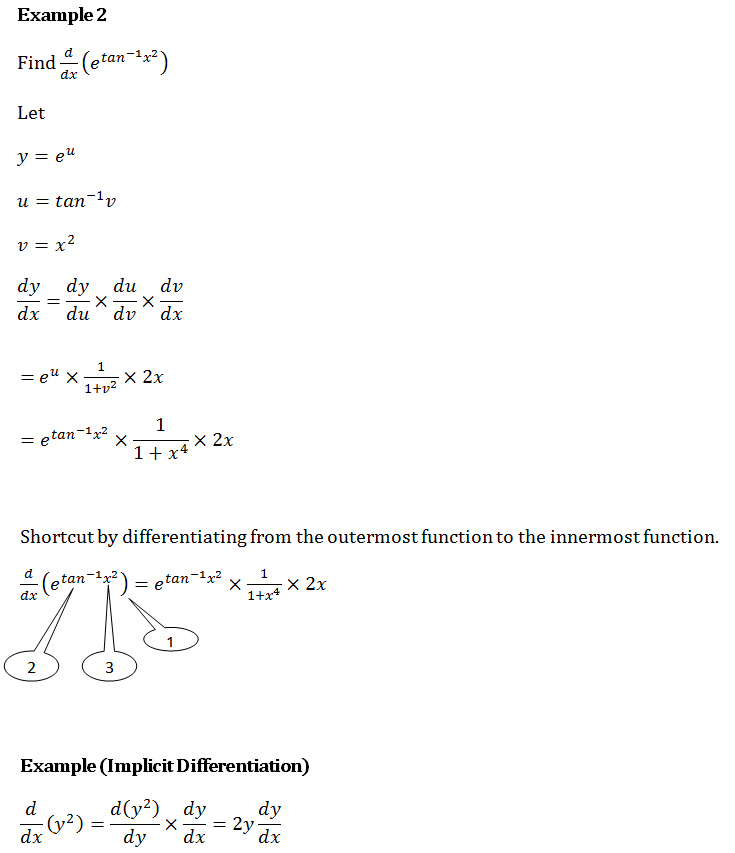
Chain rule is very useful when we need to differentiate complex functions or doing implicit differentiation.

Definite integrals involving modulus looks complicated but can be easily evaluated using a standard approach. See the following examples.


Use implicit differentiation to differentiate the following with respect to x:
y=x(x+1)(x+2)(x+3)(x+4)(x+5)
Solution
ln y= lnx+ln(x+1)+ln(x+2)+ln(x+3)+ln(x+4)+ln(x+5)


The concept of increasing function, point of inflexion and concavity can be understood with an illustration.

a. Strictly increasing. f(x) is strictly increasing when f'(x) > 0. ( x<1.423 or x> 2.577) . These points also coincide with the maximum and minimum point.
b. Strictly decreasing. f(x) is strictly decreasing when f'(x) < 0. (1.423 < x < 2.577)
c. Point of inflexion is the point where the curve changes curvature or concavity. f'(x) does not change sign, and f” (x) = 0 and changes sign. In the above graph, the curve changes from convex to concave at x = 2.
d. Concave upwards. f(x) concave upwards when f”(x) > 0 or f'(x) is strictly increasing. f(x) concave upwards at x> 2, after f'(x) reaches a minimum, at the point of inflexion.
e. Concave downwards or convex. f(x) concave downwards when f”(x) < 0 or f'(x) is strictly decreasing. f(x) concave downwards for x < 2.
Knowing how to apply Linear Composite Rule and Reverse Composite Rule in integration will make integration very simple. This will save the effort of memorizing lots of integration formulas.


 JC A Level H2 Math Tuition Singapore
You must be logged in to post a comment.