Quick Maclaurin’s series expansion using GC

In Maclaurin’s series expansion, where up to f”(0) need to be evaluated, can be done quickly using the GC.

Example

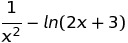
Expand Tex2Img_1402541222 up to powers of 2.

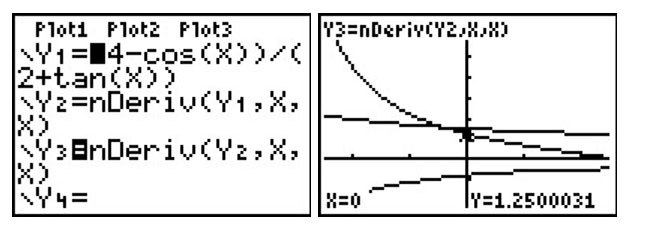
Using TI 84 Plus (OS 2.55)

maclaurin

From G.C,

f(0)= 3/2

f'(0) = -3/4

f”(0)= 5/4

Therefore using Maclaurin’s series expansion,

Tex2Img_1402541502

If powers higher than 2 such as 3 are required, then do differentiation to find the first derivative. Then enter into Y1. Y2 and Y3 will then give the second and third derivative.

Challenging Inequality problem 1

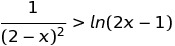
Solve the inequality

Tex2Img_1402449638

From G.C, 0.5<x< 2.81, x not equal to 2 (This is the easy part)

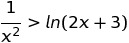
Hence solve

Tex2Img_1402449826

This is the HOT (Higher Order Thinking) part.

Method 1

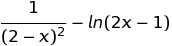
Let f(x) =

Tex2Img_1402450007

Therefore f(x+2) =

Tex2Img_1402450329

f(x+2) is translation of f(x) by 2 units in the negative X direction.

Therefore, the solution is -1.5< x<0.81, x not equal to 0

This solution combines the concept of inequality and transformation of graph.

Method 2

Replace x by x+2.

Therefore 0.5<x+2< 2.81, x+2 not equal to 2

-1.5<x<0.81, x not equal to 0

Challenging Permutation question 2

Question: 6 adults and 3 children are sitting in a round table. Find the number of possible seating arrangement if none of the children sit together.

Solution: Choose 3 out of the 6 possible slots for the children to be seated between 2 adults, then multiply by 3! for the children permutation, then multiply by (6-1)! for the 6 adult circular permutation. Ans: 14400

Principle used: Slotting principle.

Challenging Permutation question 1

Q: There are five buildings. There are 4 different colours of paint. Each building must be painted with only 1 colour. Find the number of ways to paint all the 5 buildings if all 4 colours must be used.

Solution: 5 Choose 2 to have the same colour, then multiply by 4! for the colour permutation. Ans = 240

Principle used: Grouping principle.

Factorial

Questions on factorial can appear in H2 math binomial expansion, partial fractions, method of difference, mathematical induction and probability. Knowing how to simplify and manipulate factorials are crucial to doing well.

Two commonly used techniques

1. Replace n! with n(n-1)!

2. Multiply by k/k  or k! / k!

Example 1

factorial 1


Synthetic division

Synthetic division can be used to divide a polynomial by a linear divisor, which is commonly required in H2 math and Amath.

It is faster than the traditional long division.

How to do Synthetic division

Partial fraction: Cover-up rule

Partial fraction is commonly used in binomial expansion, method of difference and integration.

When the divisor consists only of linear factors, cover up rule can be used to find the constants in the partial fraction quickly.

Example

Express Tex2Img_1400545440 in partial fraction.

Tex2Img_1400545549

By cover up rule,

1

Therefore

Tex2Img_1400546214

2

0 = A+C

3

Therefore,

fraction final


Difference between f(f-inverse) and (f-inverse)f

Some questions on functions require students to understand the difference between  ff-1 and f-1f. Though both = x, they are two different functions because their domains might be different.

Tex2Img_1400150080 while Tex2Img_1400150161

Therefore,

Tex2Img_1400149917 while Tex2Img_1400150309

Example f(x) = x+2, x> 0

Tex2Img_1400150488

Tex2Img_1400150586

Periodic, even and odd functions

H2 math syllabus 9740 did not state that periodic functions are included in the syllabus. However, questions on periodic functions have appeared in A level 2009 and 2013.

So it is good to learn periodic, even and odd functions.

Periodic functions

A periodic function has a graph with a basic pattern that repeats at regular intervals.

For example, sin x is periodic and its period is 2 pi.

sin(x) = sin(x+ 2pi)

For  a periodic function with period a

f(x) = f(x+a) = f(x+2a) = ..

Simiarly

f(x) = f(x-a) = f(x-2a) = …

i.e. f(x) = f(x+ka) where k is an integer

Even functions

A function is said to be even if f(x) = f(-x) for all values of x. The graphs of all even functions are symmetrical about the vertical axis.

cos


Odd functions

A function is odd if f(x) = -f(-x) for all values of x. The graphs of all odd functions are symmetrical about the origin. One section of the graph can be rotated about the origin through 180 degrees to give the other section.

odd


Point of inflexion and concavity

The concept of increasing function, point of inflexion and concavity can be understood with an illustration.


Concavity

a. Strictly increasing. f(x) is strictly increasing when f'(x) > 0. ( x<1.423 or x> 2.577) . These points also coincide with the maximum and minimum point.

b. Strictly decreasing. f(x) is strictly decreasing when f'(x) < 0. (1.423  < x <  2.577)

c. Point of inflexion is the point where the curve changes curvature or concavity. f'(x) does not change sign, and  f” (x) = 0 and changes sign. In the above graph, the curve changes from convex to concave at x = 2.

d. Concave upwards. f(x) concave upwards when f”(x) > 0 or f'(x) is strictly increasing. f(x) concave upwards at x> 2, after f'(x) reaches a minimum, at the point of inflexion.

e. Concave downwards or convex. f(x) concave downwards when f”(x) < 0 or f'(x) is strictly decreasing. f(x) concave downwards for x < 2.